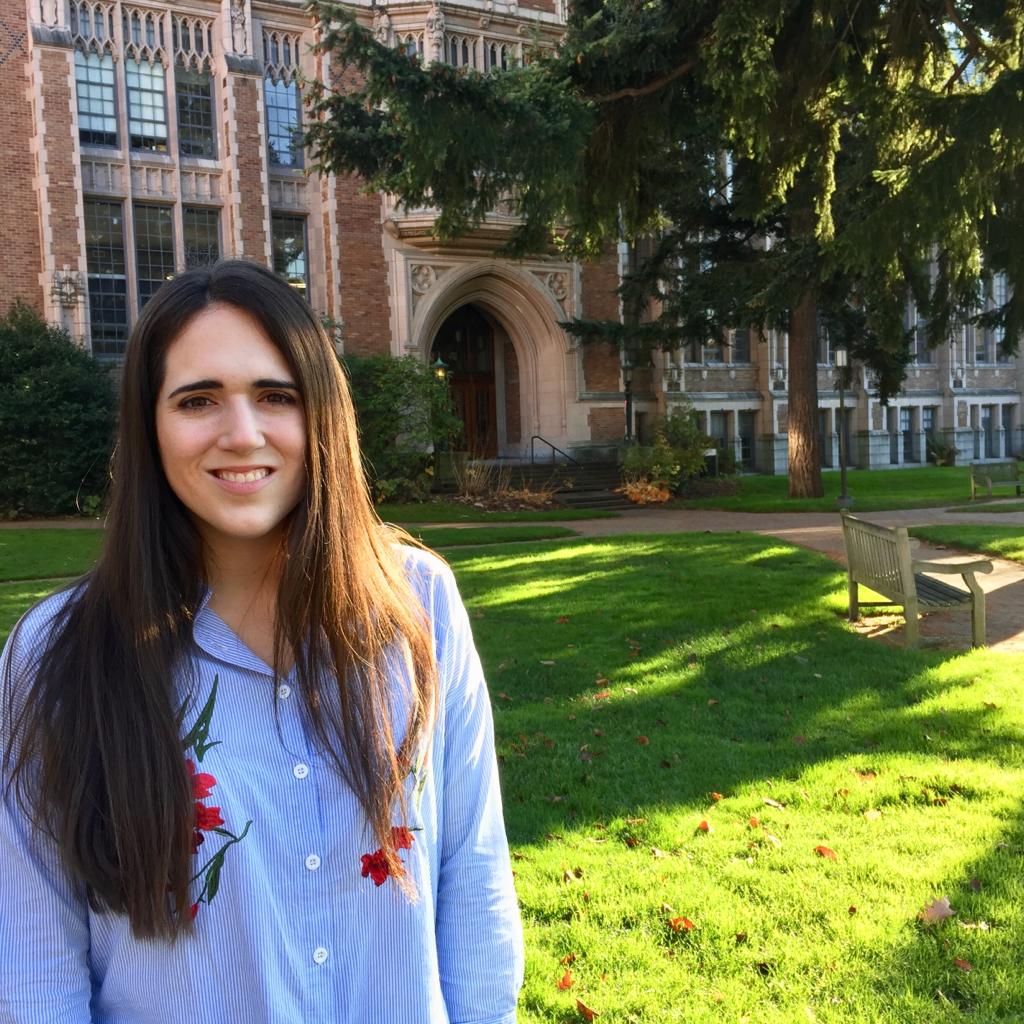
M. Cecilia Ramírez-Michelena

M. Cecilia Ramírez-Michelena (she/her)

Ph.D. Candidate in Economics

Universitat de Barcelona & Institut d'Economia de Barcelona (IEB)

Biography

I am a Ph.D. Candidate in Economics at the Universitat de Barcelona, on the 2026–2027 job market. My dissertation, Essays on Gender Inequality, Educational Choices, and Labor Market Pathways, is supervised by Profs. Lídia Farré and Andreu Arenas and examines how educational choices, institutions, and public policies shape inequality over the life cycle, with a particular focus on gender gaps in STEM, school-to-work transitions, and labor market outcomes. I draw on administrative and survey data, randomized field experiments, and quasi-experimental methods to conduct policy-relevant research in labor economics, education economics, gender inequality, and applied microeconometrics.

Alongside this research, I work to translate empirical findings into policy-relevant evidence for institutional and public-sector audiences — reflected in the fieldwork and research–practice partnerships described below — and I am seeking research and policy roles that put that evidence to direct use.

Interests

  • Education economics
  • Gender inequality
  • Public & social policy
  • Impact evaluation
  • Field experiments

Education

Research

Working papers and published work.

Abilities and Career Choices: Addressing the Gender Gap in STEM Fields

Women remain markedly underrepresented in Science, Technology, Engineering, and Mathematics (STEM), particularly in math-intensive fields. This paper investigates whether gender gaps in STEM enrollment arise from differences in students' ability profiles across domains, focusing on within-student comparative advantage in mathematics relative to reading. Using linked administrative records for students in Catalonia, Spain, we relate standardized math and reading test scores in grades 6 and 10 to subsequent enrollment in STEM-oriented high school tracks and university majors. We find that math comparative advantage accounts for about 60% of the female disadvantage in high school STEM enrollment, but only about 20% of the gender gap in university STEM major choice — a difference in explanatory power driven by the distribution of relative skills in the selected population, rather than a stronger behavioral mechanism.

Presented at the BRIDGE Economics of Education Workshop (KU Leuven) and the SEHO Annual Meeting, 2025.

Educational Gains from School Electrification in Rural Areas

This paper estimates the educational effects of school electrification in rural Uruguay by examining two distinct technologies: connection to the national electricity grid and the installation of stand-alone solar panels through Luces para Aprender, an initiative of the Organización de Estados Iberoamericanos implemented across 13 Latin American countries. We construct a panel covering the universe of rural schools in Uruguay from 1990 onward and exploit variation in the timing of electrification using a difference-in-differences design. We find that connection to the electricity grid increased the share of students meeting the minimum attendance requirement by approximately 3 percent, while having no effect on school completion. The attendance effect is concentrated in the period following the widespread adoption of laptops and mobile phones, consistent with electrification increasing students’ ability to charge and use these devices at school. The effect persists for only one year, which is consistent with nearby households obtaining electricity shortly after the school connection and thereby reducing the relative importance of school-based access. In contrast, the solar systems installed through Luces para Aprender, which offered substantially lower capacity and only a single electrical outlet, had no detectable effect on attendance or completion.

Presented at the European Association of Labour Economists (EALE), 2024.

Strategies to Increase the Take-up of Social Benefits: Evidence from a Field Experiment

We test strategies to increase take-up of a municipal support program among cuidacoches — deeply vulnerable, informal street workers in Montevideo who watch parked cars for tips — among whom fewer than half hold a work permit despite low compliance costs. In a field experiment, we randomly assign one-on-one assistance from a professional social worker to help workers complete the permit paperwork, and, within that group, randomly assign coverage of the documents' direct costs. Workers who receive one-on-one assistance are three times more likely to obtain the permit than the control group; those who also receive cost coverage are four times more likely. Providing information alone has no effect, and the intervention generates no spillover to take-up of other, non-targeted social programs.

Tablets for Deeply Disadvantaged Older Adults: Challenges in Long-term Care Facilities

We evaluate a national one-tablet-per-elder program (Plan Ibirapitá) among deeply vulnerable, institutionalized older adults in a Uruguayan public geriatric hospital — patients with dementia, low educational attainment, and no prior use of technology. Using a randomized field experiment and a difference-in-differences design, we find no significant effects on cognitive deterioration, loneliness, or self-esteem, cautioning against techno-optimism in ICT policy for the most disadvantaged elderly.

Policy & Practice

My work sits at the intersection of research design and the institutional constraints that shape whether it can actually be implemented. Across roles in Latin America, the United States, and Europe, I have engaged directly with public institutions and practitioners to design, implement, and communicate policy-relevant evidence — including field implementation of randomized evaluations with vulnerable populations, a partnership between the University of Washington and Seattle's public school system funded by the U.S. Department of Education, and the design of a funded school-based RCT in Catalonia.

School-based RCT in Catalonia

Universitat de Barcelona

This project builds on ongoing research with Andreu Arenas and Lídia Farré studying how students' abilities shape their educational choices, and how much of the gender gap in STEM enrollment in Catalonia they explain. When choosing what to study, students don't simply ask whether their math skills are good enough for a STEM career — they compare their own math skills to their own reading skills and gravitate toward whichever is relatively stronger, their comparative advantage. Girls tend, on average, to have a comparative advantage in reading rather than math, which drives a large part of the gender gap in STEM enrollment.

I secured funding from the Women and Science Program at Paris Dauphine–PSL to design and implement a randomized information intervention in secondary schools in Catalonia, expected to reach more than 2,000 students. Students will see their own math and reading grades benchmarked against those of the previous cohort that went on to pursue a STEM track in high school and STEM majors in college, testing whether this information shifts their choices toward a better fit with their comparative advantage, without discouraging participation.

I lead day-to-day project development, including treatment design, survey implementation, school engagement, budget management, research assistant supervision, and coordination with schools and education stakeholders.

Data-Driven Teacher Talent Management at Seattle Public Schools

Education Policy Analytics Lab (University of Washington)

Seattle Public Schools is the public school system of the city of Seattle: it runs the city's public elementary, middle, and high schools and is the largest school system in Washington State. Together with researchers at the University of Washington, and with funding from the Institute of Education Sciences (IES) — the research agency of the U.S. Department of Education — it set out to improve how it supports, evaluates, and retains its teachers, especially new teachers and experienced teachers facing difficulties. This work went hand in hand with a peer-mentoring and evaluation program for teachers (Peer Assistance and Review) that the school system launched in 2018–19 together with the teachers' union.

As a Research Associate, I analyzed the school system's personnel and administrative records on teacher performance, absenteeism, hiring, staffing, and retention in schools serving low-income students. I produced regular, quick-turnaround analyses to track how the mentoring program was being rolled out, and helped strengthen the school system's own capacity to use its data. I turned the practical concerns of its leadership into research questions and analysis plans through ongoing dialogue with senior officials, analysts in its Human Resources and Research & Evaluation departments, school administrators, union representatives, and program managers, and communicated findings through internal reports, technical notes, and presentations designed to inform decisions within the school system rather than for academic publication.

Field Implementation of Randomized Evaluations with Vulnerable Populations

Center for Research in Applied Economics (Universidad de Montevideo)

Served as field leader for randomized evaluations with vulnerable populations in Uruguay, including a social benefits take-up and labor inclusion intervention with more than 300 informal street workers, many experiencing homelessness, and a tablet-based digital inclusion intervention with over 120 institutionalized older adults in a public hospital. Led a team of 10 social workers and managed more than 50 volunteers across the two interventions, and designed and revised the survey instruments and field protocols they used. Coordinated day-to-day field activities under strict ethics and data-protection requirements, holding regular check-ins with ministries, municipal departments, hospitals, and frontline providers to troubleshoot fieldwork issues and keep implementation on track.

Teaching

Universitat de Barcelona

Department of Economics

B.A. Thesis Advisor · Spring 2026

Supervised undergraduate students writing their B.A. thesis on topics in public policy evaluation.

Predoctoral Instructor · Spring 2024, Spring 2025

Economics (undergraduate).

IFSA Barcelona

Lecturer · Winter 2026

International Political Economy (undergraduate).

University of Washington

Department of Spanish and Portuguese Studies

Predoctoral Instructor · Fall 2020 – Spring 2021

SPAN 103/203 (undergraduate).

Universidad de Montevideo

Department of Economics

Teaching Assistant · Fall 2014 – Spring 2015

Mathematical Economics I, Macroeconomics I, Calculus (undergraduate).

Contact